Evaluation of Express Car Washes: A Comparative Review
A comparative review of three express car washes, assessing their effectiveness in cleaning and shine, with observations on performance and results.
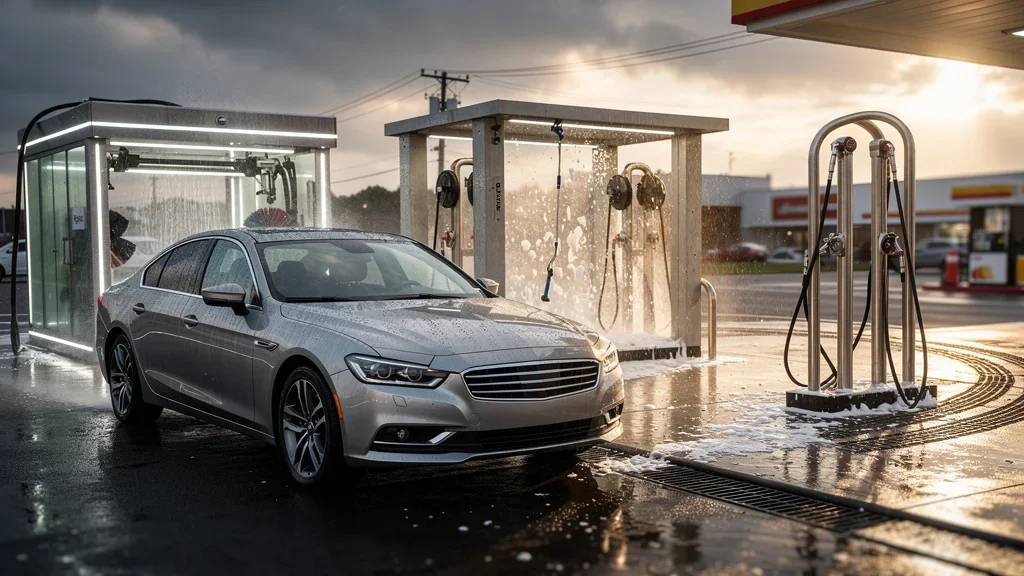
The express car wash experience at Shell Porte d’Orléans left a notable impression, as I observed foam cascading over my black hood even before the program concluded. Upon exiting the third station, I ran my hand along the lower door and detected a fine gray film that had not been removed. I also examined the bodywork in the sunlight, waiting 20 minutes in the parking lot to see what remained after a wash.
This evaluation was initiated after driving 214 kilometers over seven days with a daily-use vehicle that already bore marks on the front and lower sides. My goal was to compare three gas stations for a presentable finish without the use of a bucket, manual washing, or a detour home. I maintained a consistent approach each time: immediate exit followed by a cold return in the sunlight.
A Saturday Under the Sun
I took the car out on a Saturday at 10:30 AM, under clear skies and a temperature of 19 °C. The body showed visible road grime on the lower sides, and the front was still dotted with dead insects. It was clear that the bumper required more than a simple rinse.
I did not bring a bucket or cloth, nor did I perform any manual pre-wash. My aim was to assess the wash program as it was delivered from the station. I timed each wash: TotalEnergies Porte de Bagnolet took 7 minutes and 40 seconds, Éléphant Bleu on rue de Tolbiac lasted 8 minutes and 5 seconds, while Shell Porte d’Orléans completed the wash in 6 minutes and 55 seconds.
I consistently checked the mirrors, seals, trunk handle, lower door areas, and the hatchback’s rear during my vehicle inspection. Observations were made in full sunlight to avoid misleading impressions that might arise in the shade. This meticulous approach to examining the car zone by zone, searching for subtle flaws in the light, was also reflected in my previous article on express technical inspections. Under neon lights, a wash can appear cleaner than it truly is.
I referenced a note from ADEME regarding water usage for home car maintenance, not for cleanliness ratings but to gauge the efficiency of a brief and controlled wash. On this front, all three programs exhibited similar water usage patterns.
At Shell Porte d’Orléans, I was almost misled by the shine of the bodywork immediately after the wash. However, after taking a few steps towards the parking lot and then checking the lower door areas again, the verdict changed. The shine concealed greasy spots and trapped droplets.
Observations on Problematic Areas
Starting with the mirrors, the discrepancies became apparent. At TotalEnergies Porte de Bagnolet, I noted the least amount of water trapped in the mirror housings. However, a droplet continued to trickle from the right mirror base after parking. At Éléphant Bleu, I observed more foam in the seals around the window. Shell, on the other hand, had streaks on the rear emblem visible immediately after reversing.
I found the lower door area to be the best indicator of cleanliness, as a visual inspection alone can be deceptive. A gentle rub revealed whether the road film had been removed or if a gray veil remained. I still felt this veil on the lower hatch lip at Shell, even though the car appeared shiny from three meters away.
In terms of pre-wash cleanliness, TotalEnergies performed better, as the front was degreased before the brushes. Éléphant Bleu excelled in cleaning the hatch facade, yet I remained cautious about the plate and seals, where foam lingered longer. I ranked Shell last in problematic areas due to noticeable droplets in the mirrors and behind the trunk handle.
I also compared drying performance while driving away from the stations, where differences were most evident. On the side window of Shell, I noticed limescale forming almost immediately. The other two stations left fewer marks, but none achieved perfect drying in the contours. At Shell, the blower stopped a second too soon on the rear window, requiring me to wipe the upper edge with my sleeve.
A specific detail caught my attention during the first braking after leaving Shell Porte d’Orléans. A droplet formed at the bottom of the right mirror and fell onto the side window at the next traffic light. This small event confirmed that the finish was not completely dry; it was merely a body that appeared clean during my initial used car purchase.
Defining a True Quality Wash
I concluded that TotalEnergies Porte de Bagnolet was the most balanced station in this test. I did not choose the most expensive option; I paid 9 euros and found the least gray film on the lower doors, with minimal water trapped in the relief areas. The program felt more coherent from the start, especially on the front and lower sides.
I also noted the limitations, which were evident across all three washes. On the black hood, I detected fine circular traces in direct sunlight, which were invisible in the shade. I noticed drying halos on some windows, and the rear hatch was never perfect without a microfiber touch-up.
I kept a straightforward perspective based on usage. For a car that is merely dusty, Éléphant Bleu suffices for a quick and visible result. For a vehicle burdened with road grime, I prefer TotalEnergies, especially for a shiny finish in under 10 minutes before an evening trip. Shell left the strongest visual impression, but it did not deliver the most convincing tactile result.
I would not hesitate to have TotalEnergies Porte de Bagnolet undergo the same test again, whereas I would regard Shell Porte d’Orléans as the prime example of superficial cleaning. I concluded with the same sensation on the lower hatch lip: a gray dust still lingered on my finger after waiting. For someone willing to touch up the windows and seals manually, I would recommend TotalEnergies. For those seeking immediate shine, Shell offered the most striking visual appeal.