Budget Family Transport Summer 2026: Car, Train, or Plane?
Going on vacation with five, six, or nine passengers is becoming increasingly expensive. Discover how to manage transport costs effectively for your summer trips.

Going on vacation with five, six, or nine passengers is becoming increasingly expensive even before packing the first suitcase. With diesel prices flirting with €2.30/L since the beginning of spring 2026, highway tolls adjusted each year, and train tickets whose prices rise with the number of travelers, transport costs can represent a quarter of the vacation budget on their own. The good news: a few simple adjustments can cut this in half.
Fuel Prices Soar, Tolls Follow
This trend is nothing new, but it has accelerated. The SP95-E10 averaged €1.70/L in February 2026. Two months later, geopolitical tensions in the Middle East pushed the price per liter above €2, and diesel now averages over €2.30/L nationally. For a trip from Paris to Marseille (approximately 775 km), the fuel cost alone reaches €130 to €150 with a family vehicle consuming 7.5 L/100 km on diesel. Add €75 to €85 for one-way tolls, and the total quickly exceeds €200 each way.
The most cost-effective reflex remains to reduce highway consumption by adopting a few eco-driving habits (setting the cruise control at 120 km/h instead of 130, properly inflated tires, reasonable air conditioning). Over 800 km, reducing consumption from 7.5 to 6.8 L/100 km represents savings of €10 to €15 per tank. It’s not spectacular, but when accumulated over round trips and several summer journeys, the savings become significant.

Train and Plane: The False Good Deal for Large Families
The TGV, unbeatable for solo travelers but tricky for five passengers
A Paris-Marseille trip on OUIGO starts at €19 per adult and €8 per child. On paper, it’s attractive. In practice, these low prices evaporate as soon as you book during the summer for five people on the same train. The actual average price of a ticket on this route is around €63 per passenger. Multiply by five: the one-way trip reaches €315, or €630 round trip for a family of two adults and three children. And this calculation does not take into account baggage constraints (only one cabin bag included on OUIGO, with each additional suitcase charged at €5 to €20), nor the transfer from the station to the destination upon arrival (taxi, car rental).
The Large Family card offers a 30% discount, but it only applies to standard fare tickets, not to Prem’s or OUIGO. In the end, the train remains competitive for one or two travelers, but much less so when traveling with a group.
Low-Cost Airlines: A Mirage When Traveling Heavily Loaded
Low-cost airlines advertise fares starting at €30 or €40 per trip. However, the baggage allowance often limits you to a small cabin bag. Expect €15 to €45 per checked bag depending on the airline and the timing of your booking. For a family of five with three checked bags, the baggage surcharge amounts to around €100 to €135 each way. Add the airport transfer (long-term parking or shuttle for five, rarely below €40) and the journey to the final destination. The total often exceeds that of traveling by car, along with rigid schedules and the inability to carry strollers, car seats, or vacation gear without extra costs.
The Road in a Single Vehicle: The Equation That Changes Everything
The real lever for large families or groups of friends is cost-sharing in a single vehicle. Taking two cars for the same trip doubles the fuel, doubles the tolls, and doubles the parking fees upon arrival. For a round trip from Paris to Marseille, the difference between two sedans and one vehicle suitable for the group easily represents €350 to €450 in savings.
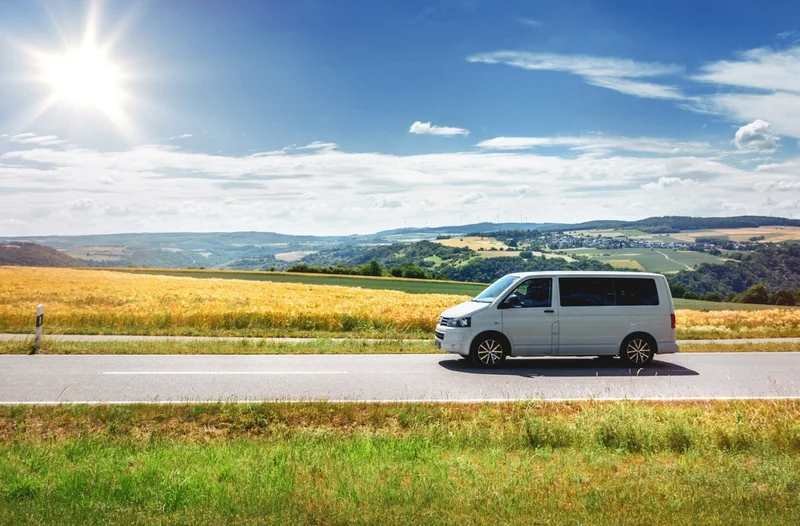
For groups of six to nine passengers, renting a 9-seater minibus allows you to consolidate all expenses into one vehicle, while maintaining the comfort of a spacious cabin and enough trunk space for everyone’s luggage. All of this can be done with a standard driving license, without additional training. When calculated per passenger, the cost per kilometer becomes unbeatable compared to trains and planes.
Four Concrete Levers to Reduce Costs
Anticipate Vehicle Rental Reservations
Rental rates increase by 30% to 50% between a reservation in May and one made in the last week of June for a departure in July. Booking your vehicle six to eight weeks before departure guarantees the best value for money, especially for the highly sought-after 7-9 seat categories in summer.
Shift Departure Days and Times
Leaving on a Tuesday or Wednesday instead of a Saturday helps avoid traffic congestion (thus consuming less) and sometimes allows for reduced toll rates on certain sections. Departing at 5 AM instead of 10 AM also allows you to drive a significant part of the journey on clear highways, reducing consumption by 0.5 to 1 L/100 km.
What Families Forget in Their Calculations
The transport budget does not only consist of fuel and tolls. Meals at highway rest areas are a cost that most families underestimate: expect to spend €12 to €18 per person for a basic lunch. For a family of five, this amounts to €60 to €90 for a single stop. Preparing a picnic before departure can save €40 to €70 per trip, or €80 to €140 for a round trip.
The supplementary insurance for the rental vehicle, often offered at the counter, also deserves to be compared in advance. Some premium credit cards already include rental coverage, which avoids paying an extra €10 to €15 per day. Ultimately, the true calculation of a motorist’s real budget includes all these additional costs, not just fuel and tolls.