BYD Enters the Japanese Market with Affordable Electric Mini Car
BYD launches the Racco in Japan, an affordable electric mini car that challenges Nissan, Honda, and other kei car leaders.
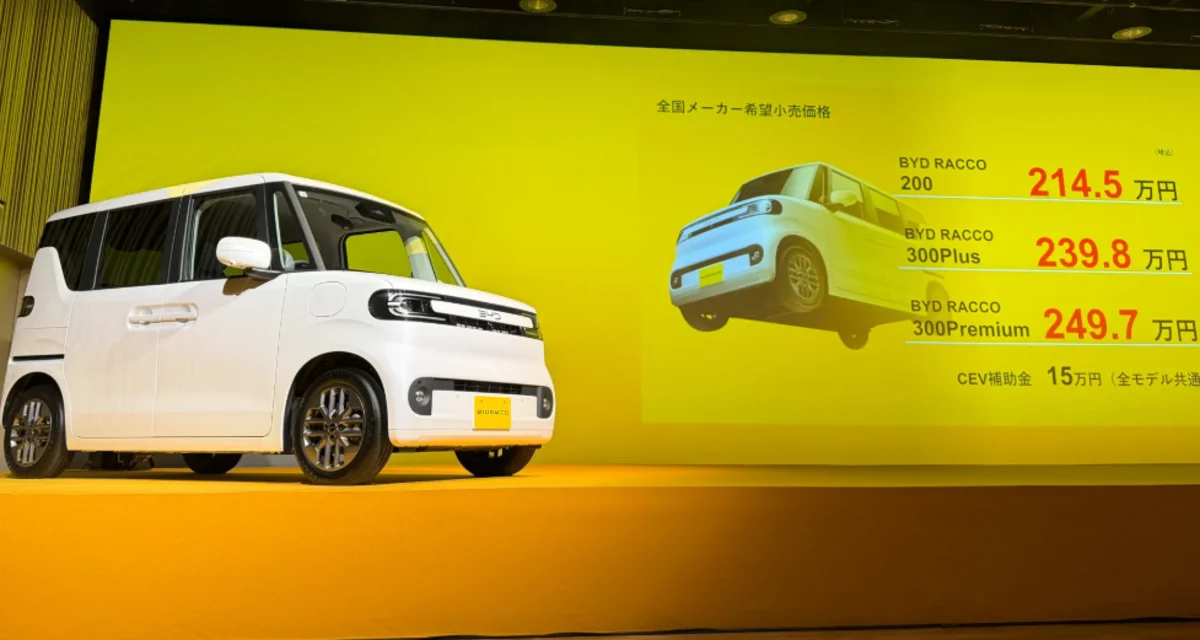
BYD is making a bold move into the Japanese automotive landscape with the launch of the Racco, an affordable electric mini car aimed at competing with established players like Nissan and Honda in the kei car segment.
The Chinese automaker is targeting one of the most significant segments of the Japanese market, where kei cars—compact and budget-friendly vehicles—account for nearly 40% of new car sales. The Racco is designed to meet the needs of urban drivers, offering a practical solution for daily commutes and navigating narrow roads.
Priced at under 2 million yen (approximately $12,210), including subsidies, the Racco boasts a minimum range of 210 kilometers. This positions it directly against the popular Nissan Sakura, which is currently one of the leading electric vehicles in Japan.
BYD Targets the Kei Car Segment
The kei car category is a unique aspect of the Japanese automotive industry, with these lightweight, compact vehicles being favored for their ease of parking and affordability. Entry-level gasoline kei cars typically start around 1.2 million yen, underscoring the importance of price in this market.
By introducing an electric mini car in this segment, BYD is taking on established Japanese manufacturers such as Toyota, Suzuki, Daihatsu, and Honda, who collectively dominate about 80% of kei car sales according to Bloomberg Intelligence.
BYD's strategy hinges on the belief that small electric vehicles can effectively serve Japanese consumers. The relatively short daily travel distances reduce battery capacity requirements and alleviate range anxiety, allowing the company to focus on compact design, energy efficiency, and lower operating costs.
The Racco against Japanese Electric Competitors
BYD faces a significant challenge as electric vehicles have yet to gain widespread acceptance among Japanese consumers. The company must effectively showcase its technological positioning and compete with domestic brands.
The Nissan Sakura serves as a benchmark in this segment, starting at around 2.44 million yen and offering a maximum range of 180 kilometers on a full charge. In 2025, it accounted for 22% of total electric vehicle sales in Japan. Honda is also preparing to enter the fray with the N-One e:, priced from approximately 2.7 million yen. Both models benefit from financial incentives that can significantly lower their final prices depending on the purchasing region; for instance, in Tokyo, the subsidized price of a Nissan Sakura can dip below 1 million yen.
For the Racco, BYD has set a base price of 2.15 million yen, with the premium version nearing 2.5 million yen. All variants will receive a subsidy of 150,000 yen for electric vehicles, as stated by Atsuki Tofukuji, general manager of BYD Auto Japan.
Beyond pricing, BYD must also win over a market that has historically favored local brands. Foreign manufacturers still represent a small share of Japan's automotive sales, although some premium European brands like BMW and Mercedes-Benz have carved out niche markets.
A Broader Japanese Strategy for BYD
The introduction of the Racco is part of a larger strategy for BYD's growth in Japan. Since entering the market over three years ago, the company has steadily expanded its vehicle lineup and strengthened its sales network.
BYD Japan aims to deliver 10,000 vehicles by the end of the month. The company currently operates 77 locations in Japan, including 56 official dealerships, to enhance consumer trust and brand visibility.
Additionally, BYD plans to broaden its Japanese offerings with new models. In January, the company announced the anticipated arrival of two more hybrids, the Atto 2 and the Seal 6, to complement its existing lineup tailored for the local market.
The Racco is a pivotal model for BYD as it seeks to establish itself in a segment long dominated by Japanese manufacturers. By offering a compact electric vehicle with a competitive price and a range that outstrips some local alternatives, BYD aims to prove its ability to adapt to the nuances of a highly insular automotive market.
Conclusion
The launch of the BYD Racco signifies a new chapter in the Chinese automaker's expansion into Japan. Targeting the kei car segment is a strategic choice, given its substantial share of national automotive sales. However, competition from Nissan, Honda, and other established Japanese brands will be fierce, particularly due to consumer loyalty to local manufacturers. The Racco's success will largely depend on its pricing strategy, actual range, and the acceptance of electric vehicles among Japanese drivers.