Comparing Organic and Ceramic Brake Pads: A Real-World Test
A detailed comparison of organic and ceramic brake pads based on real-world testing over 300 kilometers, focusing on performance, dust production, and driving sensations.
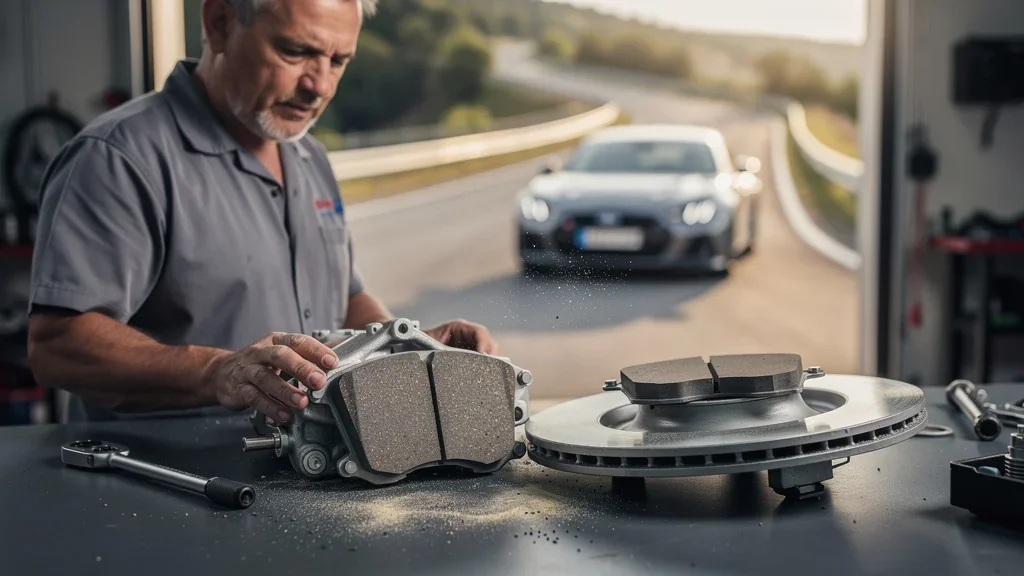
At Garage Morel on Jean-Jaurès Street, I placed my hand on the still-cool front right wheel. The rain from the previous night had seeped into the branches, leaving the aluminum with a lingering scent of dampness. I conducted a comparison of two types of brake pads—organic and ceramic—over a distance of 300 kilometers, with the car's dashboard displaying a temperature of 7 °C at the start.
Installation Day for the Brake Pads
I used a compact car with 92,418 kilometers on the odometer, featuring well-worn discs but no visible warping after 10,000 kilometers of testing. My route was consistent for each loop: starting from Jean-Jaurès Street, moving to Boulevard du Nord, and then descending down Saint-Antoine. Each trip involved 12 stops, including 4 from 50 km/h and 2 hard braking instances at the bottom of the hill, which triggered a check engine light. The trunk was empty, and I drove solo at the same time when possible. I noted the sensations experienced during cold starts, after heating up, and following a rain.
Before hitting the road, I meticulously cleaned the brake pad support areas using a blue microfiber cloth and brake cleaner, an essential step when changing brake pads. I inspected the sliders twice and noted any residue during a winter tire change. I also checked the thickness of the new pads and ensured the inner pad could return freely. This rigorous inspection method also aided my previous article on two days of brake pad testing, preventing me from mistakenly attributing noise to the material alone.
I focused on four criteria: dust accumulation on the wheel, cold bite, progressive braking in urban settings, and noise during the first morning stop—valuable for a quick technical inspection. Each test was recorded in the same order, based on 5 identical braking events. This consistent verification method helped avoid subjective judgments based on isolated impressions.
Initial Doubts During the First Kilometers
On the first morning with the ceramic pads, I experienced genuine doubt when I reached the first traffic light. The brake pedal felt smoother and slightly less responsive. Visible moisture on the discs prompted me to repeat the same stop a couple of streets later. The initial hesitation was present when cold but disappeared once warmed up. I decided to hold off on any conclusions.
Conversely, with the organic pads, I found the response to be sharper and more immediate, especially at 20 km/h, as I navigated through traffic on Rue des Peupliers. The wheels quickly became blackened with dust. After three trips, dust was already noticeable in the crevices of the branches. For urban driving, the feedback was more intuitive.
I also miscalculated a braking maneuver while ascending, too early in the break-in period for the ceramics. I heard a brief squeak and noticed a shiny spot in front of the light branch of the wheel. The following day, I realized that my break-in had exacerbated the issue. It wasn’t solely the material; my impatience played a role as well.
Distinctions After 300 Kilometers
After completing 300 kilometers, the organic pads left a thick black film on half the wheel branches. In contrast, the ceramic pads primarily produced a fine gray dust. I was able to extend my washing intervals to 21 days with the ceramics. With the organics, I had to clean the wheels after just two urban trips to restore their clean black appearance. On a light-colored wheel, the difference was striking.
On the descent of Saint-Antoine, I tested thermal performance with two hard braking sequences. The organic pads began to emit a warm odor, and the pedal felt elongated in small increments. The ceramics maintained a more stable feel, although their initial bite was less aggressive. I did not experience the same heat feedback through my foot; the fading was gradual rather than sudden.
One detail served as a reference: the small shiny ring consistently returned to the same spot on the disc, facing the outer branch of the wheel. I observed this mark after five light braking events, and it disappeared once the break-in stabilized. Such markings are reliable indicators.
Conclusions for My Use Case
For my short trips, I prefer the organic pads for their immediate bite and clear braking response from the first press. I opt for the ceramic pads when I prioritize a cleaner wheel appearance, enjoying 21 days of visual tranquility, along with a calmer performance once warmed up. My verdict is straightforward: I favor organic pads for cold response and frequent urban stops, while the ceramics are preferable for dust reduction. However, I would not choose ceramics if instant bite is expected at the first traffic light. Ultimately, it was the driving sensation at Garage Morel on Jean-Jaurès Street that influenced my preference, rather than theoretical considerations.