Increase in Car Prices: An In-Depth Analysis of the European Automotive Market | BlogMotori.com
The private car market in Europe today is a complex and dynamic landscape, following several years of challenges. This analysis offers insights into price trends, risks, and opportunities in the current automotive market.
The private car market in Europe today is a complex and dynamic landscape, following several years of challenges. Manufacturers have faced disruptions due to the pandemic, chip shortages, and geopolitical turbulence, while simultaneously managing the growing uncertainty related to electrification and CO2 regulations with global implications.
This analysis, presented in this article based on macro-level price trends over the past seven years and conducted by Jato, offers an interesting perspective on what is happening in the market, the risks to consider, and the potential opportunities in the current context. Considering Germany, France, Italy, and the United Kingdom as an aggregated multi-country market, the trajectories by segment reveal possible implications for consumers who are facing rapid and substantial changes.
Segment Share
Over the past seven years, four key segments have dominated the aggregated private car market in Europe, representing about 60% of total registrations: B-Small, B-SUV, C1-SUV, and C1-Lower Medium (Chart 1).
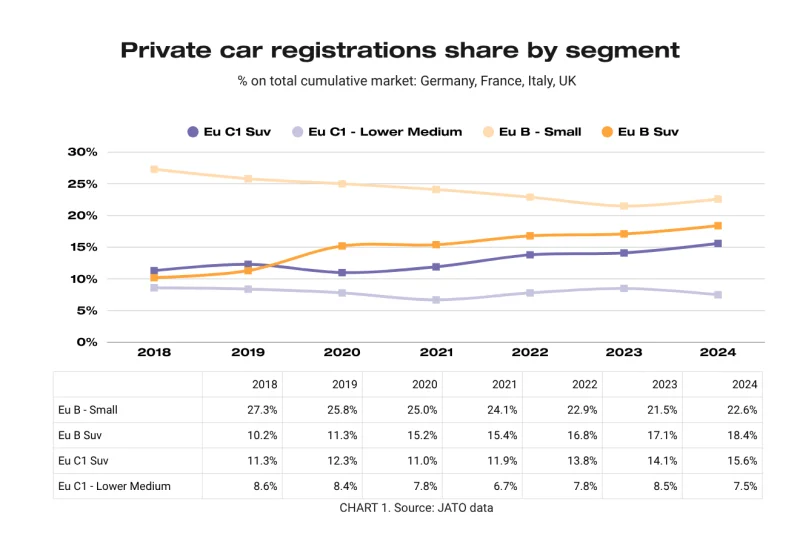
These segments are crucial not only for their volume but also because they have been at the center of the major disruptions in the industry. The SUV boom has reshaped preferences for body types, while station wagons and traditional sedans have lost ground. At the same time, the decline of diesel and rapid electrification have fundamentally altered the powertrain mix and production costs.
Each of these changes has influenced prices differently across the four countries and segments analyzed, creating the complex pricing dynamics explored in this analysis.
Year-on-Year Perspective
Measuring price growth from a year-on-year perspective, the years 2020-2021-2022 recorded the highest overall increases and respective peaks for most of these segments (Chart 2).
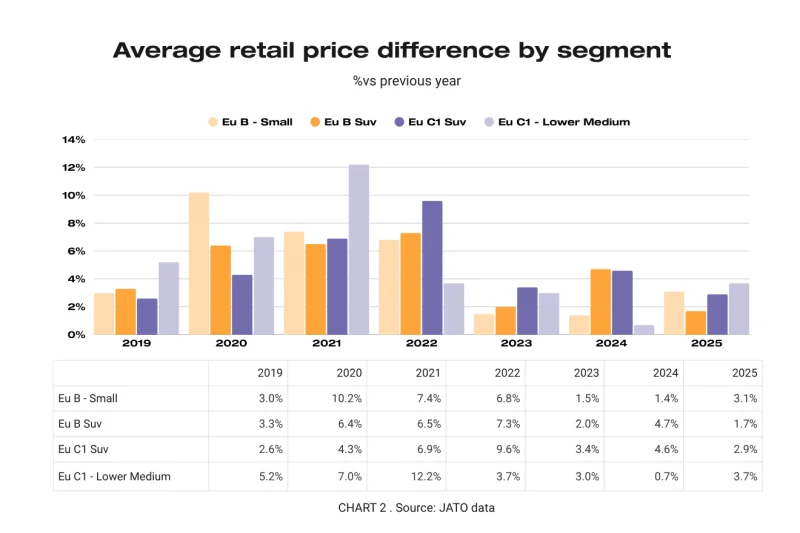
- The B-Small segment, with the highest volumes, shows its peak in 2020 and the highest increase in that year: +10% compared to 2019, equivalent to about +€1,800. In percentage terms, this is three times higher than the increase from 2019 to 2018 (which was +3%). In 2020, the other segments considered here also show a greater increase compared to the previous year, but the percentage of increase is not comparable to that recorded by B-Small.
- The C1 – Lower Medium reaches the highest peak among these segments in 2021 and its highest increase compared to the previous year: +12% compared to 2020, equivalent to about +€3,500. This is also the highest increase among these segments over the entire seven-year period considered and equals the cumulative price increase of the previous two years. In absolute terms, the cumulative increase of the previous two years is even lower, at €3,300. In the following years, this segment never exceeds a +4% annual increase.
- The C1-SUV shows the highest increase in 2022 among these segments and its peak: +10% compared to 2021, equivalent to about +€3,100. This represents the third consecutive year of price increases compared to the previous year, following +4% and +7%, and is the last clear peak of increase for the segment during the period considered.
- The B-SUV shows no evident peak over the three years, and its increase is consistently between 6% and 7%, gradually growing in absolute values from €1,500 to €2,000 per year.
Trend Analysis
Comparing 2018 with 2024, the scale of price increases in Europe emerges: average retail prices have risen by 34% for B segments and 36% for C1 segments in Germany, France, Italy, and the United Kingdom (Chart 3).
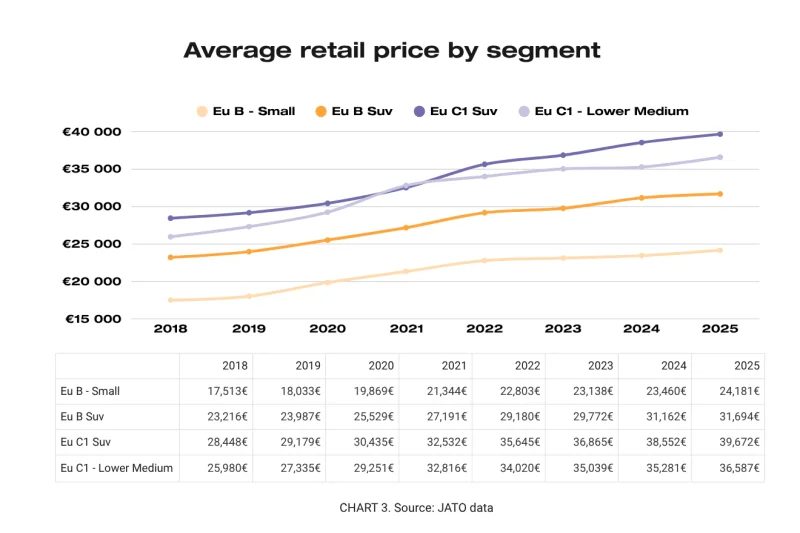
In absolute terms, the C1-SUV has recorded the steepest increases at about €10,100, while small cars in the B segment have seen the smallest increase at €5,900. However, data shows that all segments have followed remarkably similar trajectories, with the steepest price acceleration concentrated between 2020 and 2022. This parallel movement among segments suggests that industry-wide cost pressures and profit preservation measures, rather than segment-specific factors, have driven these unprecedented increases.
Price Differences Within Macro-Segments and Body Style Clusters
The price gap between SUVs and traditional body styles within each segment tells an interesting story. Starting from the expected premise that SUVs command higher prices, both B and C1 segments have seen their price differentials fluctuate significantly during the analysis period.
By 2024, the percentage price gaps have largely returned to pre-2020 levels. However, both segments experienced a notable pattern of compression and expansion between 2020-2022, where price differentials first narrowed and then expanded again, each with distinct characteristics.
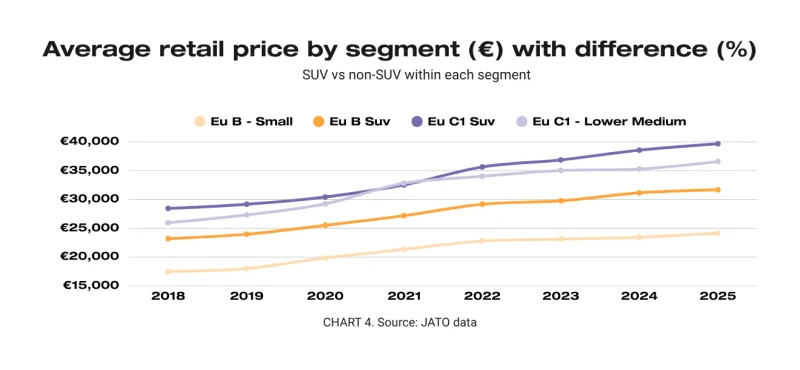
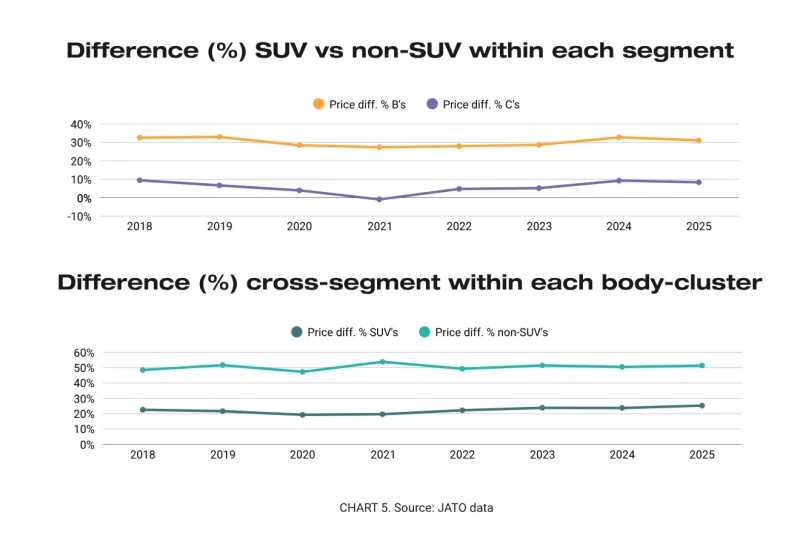
Charts 4 and 5 reveal the following patterns:
Within the B segments, the price premium for SUVs over traditional models fluctuates between 27% and 33%. The gap has followed a predictable pattern: narrowing in 2020-2021 (reaching its lowest point in 2021), then expanding again to 2018-2019 levels by 2024. However, while the percentage gap has returned to historical norms, absolute values tell a different story. In 2024, B-SUVs cost €7,700 more than small cars in the B segment, compared to only €5,700 in 2018. Notably, the price differentials in the B segment are both larger and more consistent than those in C1.
Within the C1 segments, the premiums for SUVs are much smaller, ranging from only 9% to -1% – significantly, the premium completely disappeared for a brief period in 2021. This represents a much wider swing of 10 percentage points compared to the more stable pattern of the B segment. As with the B segments, percentage gaps have returned to pre-2020 levels, but absolute differences have grown: C1-SUVs now cost €3,300 more than traditional C1 models, up from €2,500 in 2018.
Comparing between segments by body style:
Within the SUV category, C1-SUVs maintain a premium of 19-24% over B-SUVs. This gap narrowed during 2019-2021 but has since expanded beyond pre-2020 levels. In absolute terms, the increase is significant: C1-SUVs now cost €7,400 more than B-SUVs, compared to €5,200 in 2018.
Within traditional body styles, the segment gap is much larger and more stable, ranging from 47-54%. The difference has grown from €8,500 in 2018 to €11,800 in 2024.
The data reveals a critical insight for OEMs. While percentage price premiums have returned to pre-pandemic norms, the cost barriers between segments and body styles have escalated permanently. This creates new competitive dynamics where the boundaries of traditional segments are under pressure, potentially reshaping customer migration patterns and brand positioning strategies.
The Price Migration Phenomenon
The analysis reveals a surprising market dynamic: today’s compact models cost as much as the mid-size variants from just a few years ago. This "price migration" effect demonstrates how inflation and external factors have fundamentally shifted the European market landscape.
The pattern is clear. As prices rise across all segments, lower-tier models reach price points that higher-tier models occupied in recent years. In particular, traditional B segment cars now cost as much as B-SUVs did in 2018-2019, while traditional C1 models have reached the price levels of C1-SUVs from 2021-2022 (Chart 6).
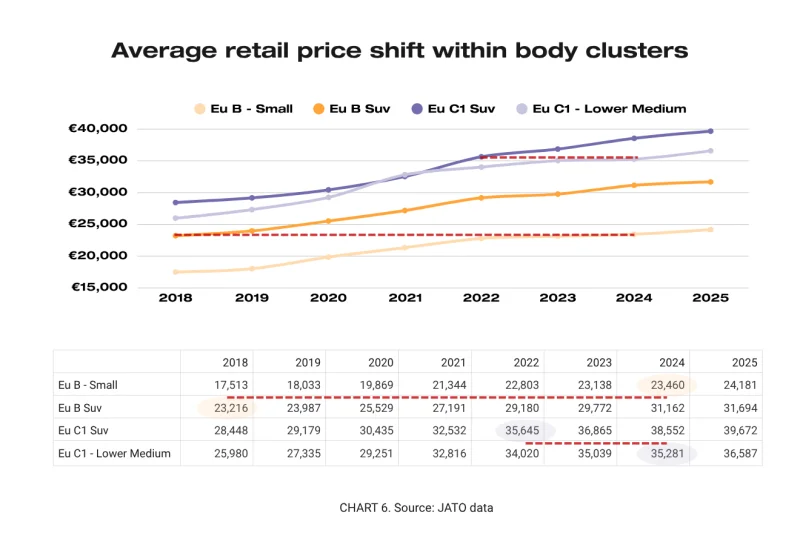
Key findings:
Within the B segments: Traditional models have "caught up" to the prices of SUVs from 2018-2019, a five-year migration period.
Within the C1 segments: Traditional models have reached the prices of SUVs from 2021-2022, a migration period of only two years.
The data reveals an important insight: the greater the initial price gap, the longer the migration period. The B segments, with their substantial SUV premiums of 27-33%, required five years for price convergence. The C1 segments, with minimal gaps from 9% to -1%, saw convergence in just two years.
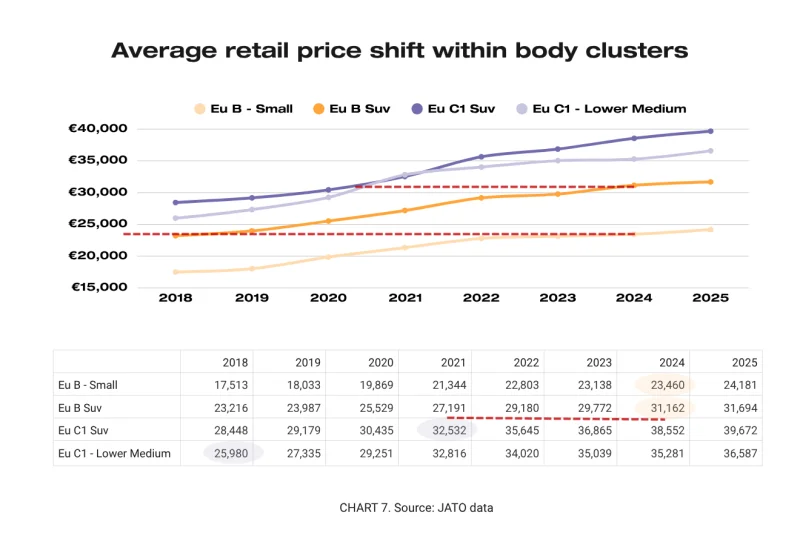
SUV prices are shifting across different size categories (Chart 7). By 2024, a B-SUV costs as much as a C1-SUV did in 2020-2021. The smaller SUV has reached the price of the larger one in about 3-4 years, essentially eliminating the €5,000 gap that existed in 2020. Non-SUV cars have not shown the same price convergence during this period, partly because the price difference between B-Small and C1-Lower Medium was greater at the outset.
Price differences between 2018 and 2024 reveal some notable trends:
By segment, within B and C, prices have grown approximately 34% and specifically:
between B-Small and B-SUV, from €5,700 to €7,700.
between C1-Lower Medium and C1-SUV, from €2,500 to €3,300.
By body style cluster, between B and C1, prices have grown by 40% and specifically:
between B-SUV and C1-SUV, from €5,200 to €7,400.
between B-Small and C1-Lower Medium, from €8,500 to €11,600.
What This Means for OEMs
The analysis reveals an expansion of the price spread between the most affordable and the most expensive vehicles within the segments examined, with complete data for 2025 still pending.
These findings go beyond simple price comparisons, offering deeper insights into market absorption patterns and accessibility dynamics. They provide a foundation for understanding the implications of broader trends and allow for further market analysis.
Given the significant variations from country to country within this four-market view, these insights help assess potential impacts on customers along two key dimensions: purchasing behavior (including alternative mobility solutions, financing versus cash purchases, and ownership versus usage models) and vehicle selection (preferences by segment and type).
In summary, the escalation of prices in the European automotive market reflects a confluence of global challenges and structural changes. Although growth has slowed after 2022, the elevated baseline levels suggest a new normal, with opportunities for innovation amid persistent risks.