Testing Five Public Charging Stations in One Day with My Corolla
A day testing five public charging stations with a Toyota Corolla reveals insights on real-world charging experiences, highlighting the challenges and differences in performance.
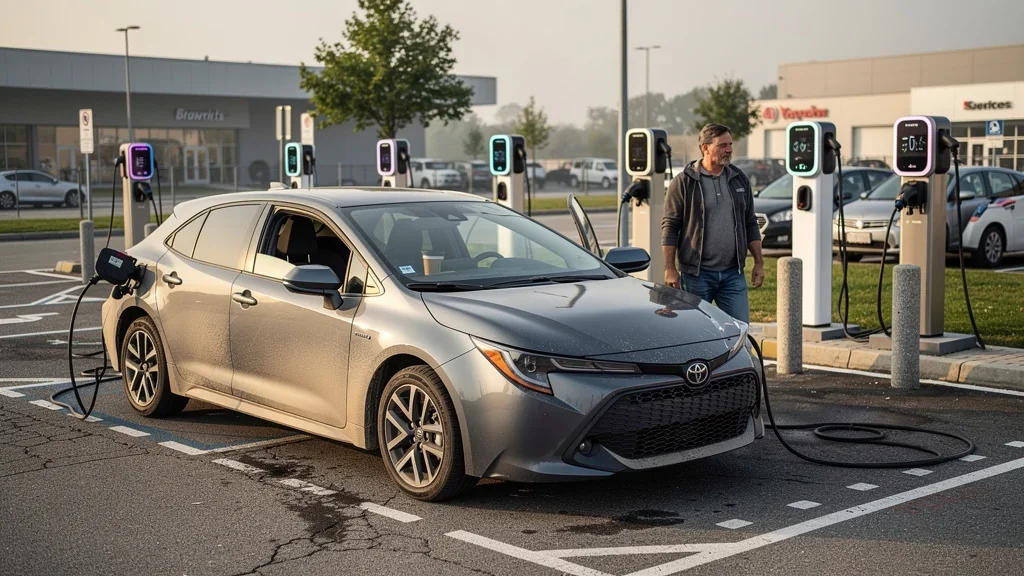
I parked my Toyota Corolla at an angle in the lot of Les Quatre-Pavillons shopping center, located in Lormont, near Bordeaux. The Type 2 cable was already stretching a bit too short towards the charging port. I plugged in, saw the indicator light turn green, and quickly realized that charging wouldn't be the only topic of discussion. This test began because one charging station was reported as available, and I wanted to verify if the session would actually start, not just if the screen displayed a promise of connectivity. I went through five stations in a single day, starting at 9:10 AM and wrapping up at 5:40 PM, armed with a KiWhi Pass badge and the app at the ready.
The Initial Hurdle Before Charging
I designed this test around very typical journeys, involving back-and-forth trips around the periphery, a grocery stop, and then a longer break near the shopping center over several weeks. My goal was to see how my Corolla performed under real-world conditions, rather than in a controlled test environment. After months of plugging the car into neighborhood AC charging stations, I initially focused on starting the session, then on the displayed power, and finally on a quick exterior wash. On this day, I maintained the same habit of checking at each stop: RFID badge, Type 2 cable, and a glance at the dashboard screen before moving away.
The scene struck me immediately at the first charging spot, as I parked at an angle and the charging port was not aligned with the pole. I had to move forward almost half a car length and then reverse slightly just to avoid putting strain on the connector. The short cable reminded me that the parking lot was designed for a different type of vehicle, not my Corolla. At another spot, a shopping cart was left next to the charging station, forcing me to back up again. At that moment, I realized that the charging station wasn’t the only point of friction.
I followed a simple protocol across the five stations, noting the time from plugging in to authentication and the first click of the lock. At the first station, I authenticated in 11 seconds. At the second, I launched the app before plugging in. At the third, I did the opposite. The fourth station saw the lock click after 7 seconds, while the fifth took 1 minute and 18 seconds. Once the Corolla's display indicated it was charging, I stayed for a few more moments to ensure the port light remained steady.
I also kept an eye on the station limits, as an available charging station isn’t necessarily one that will work on the first try. I encountered two spots occupied by cars that weren't plugged in and saw such poorly placed signage that I almost chose the wrong side of the cable. Once, I thought a station was ready only to find that the parking area blocked access, costing me ten minutes to maneuver again. In this type of test, these details are just as crucial as the technical specifications.
What I Measured at Each Station
At all five stations, I awaited the little click of the connector lock as a true signal to start. When the session initiated, I observed the charge port light blinking at first, then becoming steady, and the dashboard screen finally showing the rising percentage. At two stops, the initiation was almost instantaneous. At another, the station appeared operational with its LED lit, but then fell silent, forcing me to linger next to the car longer than expected. This hesitation between a genuine start and a false one reminded me of my previous article on an auxiliary battery.
The results were more varied than I had anticipated. I experienced two successful charges, one session that started but dragged on, and two failures where the power remained at 0 kW despite the screen indicating readiness and the cable being locked. At the best station, I gained a small charge in 28 minutes, which seemed reasonable for a grocery stop. Conversely, at the slowest station, I waited 23 minutes for barely any charge before returning to the car instead of letting it work alone.
The difference between the displayed power and the actual power received by my Corolla was striking at the station advertised as 22 kW. My onboard charger never exceeded 3.4 kW, making it clear that a station could display high capacity without delivering any significant charge. The display can be reassuring, but I didn’t see the battery percentage rise any faster just because the panel showed a high number. This discrepancy reminded me that a powerful station doesn’t matter if the car can’t accept more.
After 1 hour and 42 minutes at the longest session, I touched the Type 2 cable. It felt slightly warm, not hot, just enough for me to notice. I kept my hand on it while watching the car's display, wanting to ensure that the power remained consistent. This small detail seemed more telling than any grand discussion about charging. I noted this contact in my notebook and used it to compare the other stops.
The Station That Cost Me Time
The most frustrating station of the day initially gave me hope that everything would work smoothly. I plugged in, saw the lock engage, validated the authentication with my badge, but the screen remained normal without sending any current. I waited 41 seconds in front of a LED that stayed lit, and the session remained at 0 kW as if nothing had happened. This silence felt more painful than a clear failure because everything seemed in place.
The warning signs were there, but I dismissed them too quickly. The charge port light flickered oddly, and there was an unusual delay between plugging in and the click of the lock, almost as if the station hesitated. I also observed a brief rise that lasted 2 minutes and 36 seconds before dropping sharply, which forced me to return to the car instead of walking away. I ultimately had to disconnect, reconnect, and spent more time monitoring than charging.
The most frustrating aspect was the time lost due to misleading GPS. I moved the Corolla from one spot to another, reconnected, and realized that the issue sometimes stemmed from the placement or communication between the station and the car, not just the car itself. I even forgot to validate the authentication on the app once, and the connector locked without starting the session. I learned that a locked connector doesn’t necessarily mean current is flowing.
At this station, the order of actions mattered more than I had expected. I had to check whether I needed to authenticate before plugging in or the other way around, as the network didn’t accept the same sequence everywhere. I discovered that a simple deviation from routine could cause a session to fail even when everything appeared ready on the screen. After this experience, I kept my RFID badge in my pocket and stopped assuming that an available station was already a ready one.
Insights Gained About the Corolla
By the end of the five stations, I had a clearer picture of what my Corolla could handle. I experienced two successful initiations, one hesitant start, and two outright failures or near failures, with charging either stuck or dropping too quickly. Out of these five attempts, only two yielded a truly usable charge. For my daily drives, this means I can’t rely solely on the station’s screen.
My overall impressions stem from both parking situations and raw technique. When I had to park at an angle, the cable pulled too tightly, and I spent my time ensuring the connector wasn’t straining, while a well-designed parking spot allowed me to leave almost immediately. I realized that cable length, parking angle, and port position weigh almost as heavily as the badge or the station itself. At Les Quatre-Pavillons, this difference was evident from the very first attempt.
My conclusion is straightforward: I will keep the two stations that initiated the session promptly. I will discard the other three that left me at 0 kW, those that cut off too early, and those that made me circle around the car without making progress. For a stop where I can stay near the car for ten minutes and verify the badge or connection sequence, they’re acceptable. For a quick stop, I’ll avoid them.
The contrast between a station that appeared ready and the Corolla, which didn’t register any increase for several seconds, remains the clearest image from the day. I learned to focus less on the panel and more on the moment when the percentage finally starts to rise on the dashboard, which also helped me diagnose the engine light. It’s this transition that builds my confidence, not the glowing logo or the announced figure. At Les Quatre-Pavillons and elsewhere, I evaluate a station based on its first three minutes, not its promises.