Volkswagen ID. California Cruise: The Electric Camper Set to Launch in 2026
Volkswagen is set to unveil the ID. California Cruise, a fully electric camper, at the Caravan Salon 2026 in Düsseldorf, marking a significant expansion in its camper lineup.
Volkswagen is gearing up for a significant shift in its camper lineup with the upcoming debut of the ID. California Cruise at the Caravan Salon 2026 in Düsseldorf. This new model, fully electric, is built on the foundation of the Volkswagen ID. Buzz.
The introduction of the ID. California Cruise marks a pivotal moment for the California family of campers. Currently, Volkswagen utilizes the Multivan as the base for its California models, while the larger Crafter is transformed into the Grand California. However, there has been a noticeable gap in the lineup for a 100% electric camper.
The ID. California Cruise aims to fill this void, and it is expected to be just the beginning. Volkswagen has hinted at a new generation of electric campers, with various models slated for gradual release by 2028. For now, many details remain under wraps, particularly regarding the final interior layout.
ID. California Cruise Built on the ID. Buzz
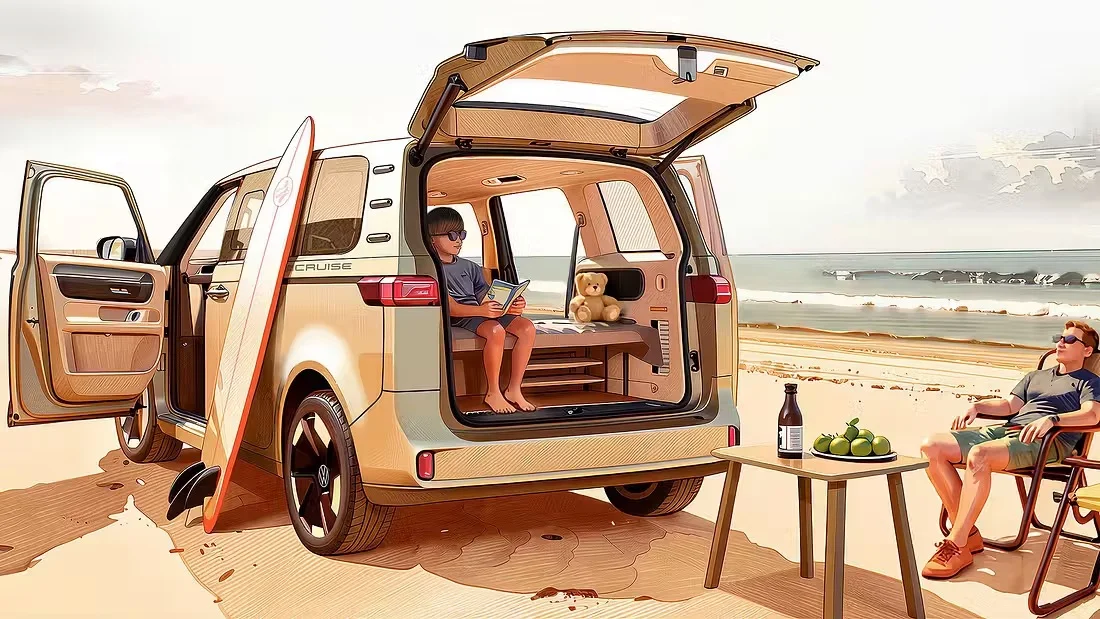
The concept of converting the ID. Buzz into an electric camper has been in discussion for some time, but it has yet to materialize into a true California model. The Cruise is set to bring this vision to fruition. Volkswagen has provided a sneak peek of the interior, revealing a rear bench that converts into a bed. However, traditional camper features are not yet visible.
One challenge that arises from the unique layout of the ID. Buzz is its two sliding side doors, which offer convenience in daily use but limit available space on the sides for installing kitchen and living amenities. The preview image from Volkswagen does not showcase a raised or pop-up roof, which would allow occupants to stand inside the vehicle.
As a result, the Cruise may represent a relatively straightforward model, primarily designed for short trips and onboard sleeping. Volkswagen has yet to finalize the configuration, so further details will be necessary to understand what features will be included.
Range of Up to 485 km for the ID. Buzz Lineup
On the technical side, Volkswagen has not disclosed the specific configuration for the ID. California Cruise. However, the ID. Buzz lineup offers several options. There are two wheelbase choices and motor configurations ranging from 140 kW (190 hp), 210 kW (286 hp), and up to 250 kW (340 hp) in the all-wheel-drive GTX version.
Depending on the chosen configuration, the declared range can vary from 359 to 485 kilometers. Charging capabilities can reach up to 200 kW in compatible versions. Under optimal conditions, Volkswagen states that users can recover enough energy for nearly 230 kilometers in about 20 minutes.
The impact of the camper setup on weight, consumption, and therefore range remains to be seen. Features like beds, potential furniture, and additional equipment will increase mass compared to a standard ID. Buzz. Specific data for the California Cruise has not yet been released.
Volkswagen Plans More Electric Campers by 2028
The most intriguing aspect may extend beyond just a single model. Volkswagen has announced that the ID. California Cruise will be the first in a family of fully electric campers expected by 2028. This opens the door for vehicles of varying sizes and configurations, although detailed plans for the future lineup are not yet available.
There is potential for a larger model that could align with the philosophy of the Grand California, but this remains speculative and has not been officially announced. The first concrete event will be the Caravan Salon in Düsseldorf in 2026, where Volkswagen is expected to clarify the cabin configuration, onboard living solutions, and, importantly, the combination of battery and motor that will be selected.
The ID. California Cruise will need to tackle one of the most compelling challenges of the new generation of campers: merging the freedom typical of travel vans with the range and charging times of an electric vehicle. This model will be the first step in a broader range set to expand by 2028.