
EU Reimport of a Used Car – Auto Blog from Experience 🚗🚙
What to really check for damage when EU reimporting a used car. Buyers often find a bargain, but the low price can sometimes come with hidden issues.
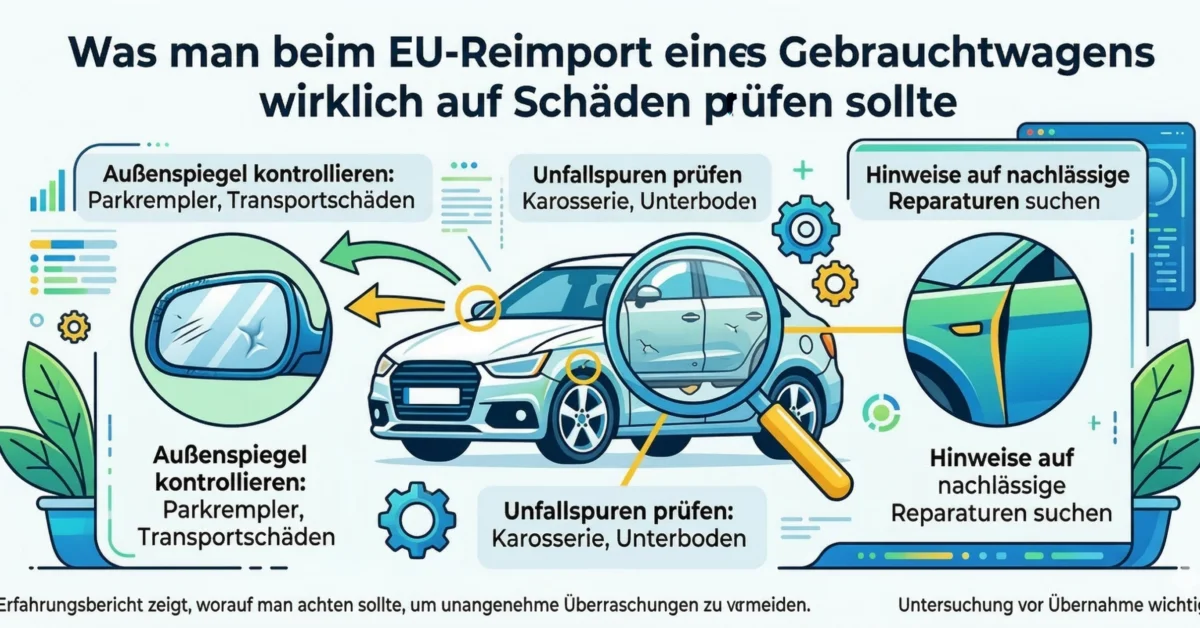
What to Really Check for Damage When EU Reimporting a Used Car
When purchasing a vehicle through EU Reimport, buyers often find a genuine bargain – but the low price can sometimes come with a catch. Reimported vehicles frequently travel long distances on transporters before reaching the buyer. During this journey, damages can occur that are often concealed or omitted in the advertisement. By taking a thorough look at the vehicle's condition before taking possession, buyers can avoid costly follow-up expenses.
It is particularly noticeable that many buyers focus on major damages during the inspection, overlooking small but expensive details. This report outlines step by step what really matters.
EU Reimport of a Used Car
Infographic: The 6 Most Important Inspection Points for EU Reimport Vehicles
Table of Contents
- Bodywork and Gaps – First Look, Greatest Benefit
- Side Mirrors – Underestimated Weak Point in Reimported Vehicles
- Tires, Rims, and Brakes – The Often Neglected Underpinnings
- Interior, Electronics, and Maintenance History
- Similar Experiences on the Blog:
Bodywork and Gaps – First Look, Greatest Benefit
The first walk around the vehicle is the most important. It is essential to pay attention to uneven gap dimensions between doors, the hood, and fenders. Deviations from these measurements are a strong indication of previous accident repairs. Fresh paint jobs often reveal color discrepancies or different gloss levels – particularly noticeable in daylight.
The underbody also deserves attention: fresh underbody protection layers over welds or rust can conceal prior damage. If unsure, the vehicle should be inspected from underneath on a pit or with a mirror and flashlight.
Side Mirrors – Underestimated Weak Point in Reimported Vehicles
Side mirrors are often the first places where previous parking bumps or transport damages become apparent. A slight misalignment in the housing, hairline cracks in the plastic, or a poorly fitting cover – all of these indicate past damages. Overlooking these areas can lead to follow-up costs that quickly reach three-digit figures.
The following table shows what to specifically look for when inspecting the mirrors:
| Inspection Point | What to Look For | Risk of Defects | |----------------------|----------------------|---------------------| | Housing | Cracks, scratches, color deviations | Indicates transport damage or repairs | | Mirror Glass | Chips, stains, fragments | Limited visibility, expensive replacement | | Electric Adjustment | Function in both directions | Defective motors – costly repair | | Heating Function | Fogging during operation | Dangerous visibility limitation in winter | | Folding Function | Smooth operation, no wobbling | Damaged joint from parking bumps |
AUTODOC Germany informs: “Properly adjusting the side mirrors is an important safety aspect when driving. The side mirrors should be adjusted so that you can just see a small part of your vehicle at the bottom, while the blind spot remains minimal. A correctly adjusted side mirror ensures that the horizon runs approximately in the middle of the mirror, allowing you to keep both the road and the traffic space in view.”
According to the Federal Statistical Office, over 40,000 traffic accidents occur annually due to inadequate visibility or improperly adjusted mirrors. A vehicle with damaged or improperly adjustable mirrors is not only a cost risk – it is also a safety issue. Replacement parts for defective side mirrors can be found at Pkwteile DE, where a wide range of original parts and quality alternatives for nearly all vehicle models is available.
Tires, Rims, and Brakes – The Often Neglected Underpinnings
Reimported Vehicles often come from countries with different road conditions or climates. This is often reflected in the tires: rubber from southern European markets can be brittle and cracked despite sufficient tread depth – a sign of excessive UV exposure. The age of the tires can be read from the DOT number on the sidewall.
Rim damage is also an important indicator. Dents or scratches on the rim edge indicate frequent curb contact. The brake discs also deserve a close look: grooves, rust, or uneven wear can indicate worn or damaged brake pads.
Interior, Electronics, and Maintenance History
A musty smell or damp carpets in the interior are clear warning signals – either for water damage or poorly resolved sealing issues. All electrical functions should be systematically checked: power windows, air conditioning, infotainment, seat heating, and of course, all lighting elements.
The maintenance history of a reimported vehicle is often incomplete or only available in the language of the country of origin. It is important that at least oil change intervals and major inspections can be documented. If these records are completely missing, it should significantly affect the purchase price – or the purchase should be reconsidered.
The following points should always be documented in writing when purchasing a reimported vehicle:
- Current mileage and plausibility with maintenance records
- Completeness of vehicle documents (Registration Certificate Part I + II)
- Condition and age of the tires (DOT number)
- Function of all side mirrors including electric adjustment and heating
- Last TÜV report and entries in the service book
FAQ – Frequently Asked Questions about EU Reimport
Click on the respective question to reveal the answer ▼
▼ Is an EU reimport vehicle fundamentally worse than a domestic one?
No – not automatically. Many reimport vehicles are in impeccable condition. The risk lies in the lack of transparency regarding the history and potential transport damages that should be specifically checked before purchase.
▼ How can I tell if a side mirror has been repaired or replaced?
Look for color discrepancies on the housing, uneven gap dimensions to the door frame, and scratches in the paint area around the mirror. A stiff or jerky electric adjustment can also indicate a poor repair.
▼ Can I register a reimport vehicle in Germany without any issues?
Yes, EU reimport vehicles can be easily registered in Germany as long as all required documents are available. In some cases, an individual approval by a certified inspector is necessary, for example, if technical adjustments (e.g., lighting) are missing.
▼ Which parts are most commonly damaged in reimport vehicles?
In addition to side mirrors, bumpers, door edges, and rims are frequently affected. Transport on car carriers also often leads to small stone chips on the hood or cracks in windshields.
▼ Is an independent appraisal worth it before purchase?
Yes, in any case. A DEKRA, GTÜ, or TÜV appraisal costs between 100 and 200 euros and can protect against expensive surprises. Especially for vehicles in the higher price segment, this step is a sensible investment.