RUF B8: A New Era with a 1,000 HP Twin-Turbo Boxer V8
RUF unveils the B8, a 1,000 HP twin-turbo boxer V8 engine, pushing the limits of high-performance automotive engineering.
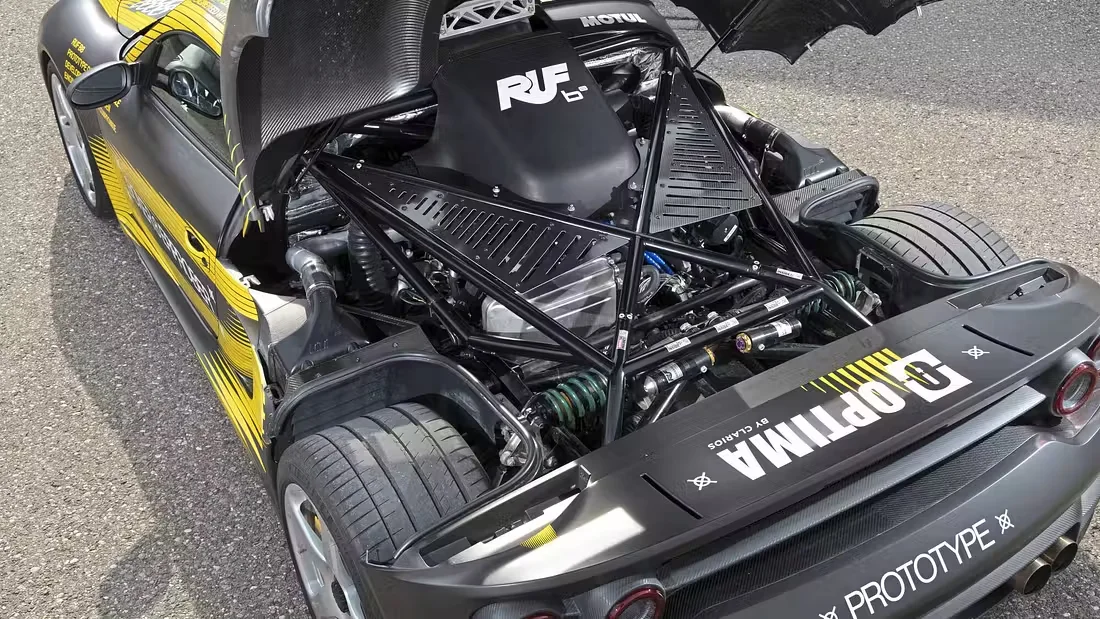
When discussing RUF, high-performance sports cars rooted in the Porsche legacy immediately come to mind. However, the German manufacturer is pushing the boundaries further with the introduction of a completely new engine. Known as the B8, this 4.8-liter twin-turbo boxer V8 engine is capable of exceeding 1,000 horsepower and generating 1,000 Nm of torque, placing it in the elite category of hypercar powertrains.
The project is currently in the experimental phase, showcasing the engineering prowess of RUF and potentially laying the groundwork for a future in-house developed supercar.
A Boxer V8 Engine Designed to Exceed 1,000 HP
At the heart of this initiative is an innovative four-liter boxer engine with a displacement of 4.8 liters. According to details released by RUF, the engine features a 90-degree bank angle, a design choice aimed at maintaining compact dimensions while delivering high performance. The goal is to create an engine suitable for top-tier sports cars, where weight distribution and compactness are critical for optimal handling.
Power is supplied by two high-performance turbochargers, and the exhaust system includes optimized wastegate valves to enhance pressure management and power delivery.
The construction of the engine emphasizes quality materials. Key components are manufactured in Kassel using advanced casting techniques with sand core molding, a process that ensures high precision, strength, and durability.
Testing on the CTR3 and Development Challenges
For initial dynamic testing, the new RUF B8 has been mounted on a specially modified CTR3. To accommodate the longer engine compared to those traditionally used in the vehicle, the chassis has been extended by 100 millimeters. The prototype combines the new engine with a six-speed manual transmission, channeling all power to the rear wheels.
The decision to maintain a manual transmission, despite the immense power, aims to provide a direct and engaging driving experience, allowing the driver complete control over the vehicle.
The CTR3 serves as an ideal testing platform due to its construction from carbon fiber, aluminum, and steel, with a reported weight of just 1,375 kilograms. In its standard configuration, it can already achieve a top speed of 375 km/h, a figure that could potentially be surpassed with the new engine.
Cooling and Transmission: Key Challenges
Developing an engine exceeding 1,000 horsepower presents particularly complex technical challenges. One of the most critical aspects involves the transmission, which must handle torque exceeding 1,000 Nm without sacrificing reliability and precision. Testing has highlighted the necessity for extremely accurate gear shifts to maximize the engine's potential.
Significant attention has also been given to cooling. The high temperatures generated by the engine necessitate the development of specific solutions, including systems that combine water and air cooling to manage thermal loads even under the most demanding conditions.
A Prototype That Could Lead to a New Supercar
Currently, the RUF B8 remains an experimental project, with no production model announced yet. However, according to Alois Ruf, the new engine could serve as the foundation for a completely new supercar. Among the ideas under consideration are the integration of all-wheel drive and a dual-clutch transmission, solutions that would enable even more effective use of the immense power available.
The question of production remains open. Given the technical complexity of the engine and the high manufacturing costs, a limited series production seems more likely than mass production.
In any case, the RUF B8 project reaffirms the German manufacturer's commitment to exploring unconventional technical solutions. With a twin-turbo boxer V8 engine exceeding 1,000 horsepower, RUF demonstrates that there is still room for innovation in the realm of high-performance engines, offering a unique interpretation that could shape the future of exclusive supercars.