
Oil Filter Mishap Leads to €400 Repair Bill
A mishap during an oil change led to a costly repair bill of €400 due to a poorly installed oil filter. A firsthand account of the mistakes made and lessons learned.
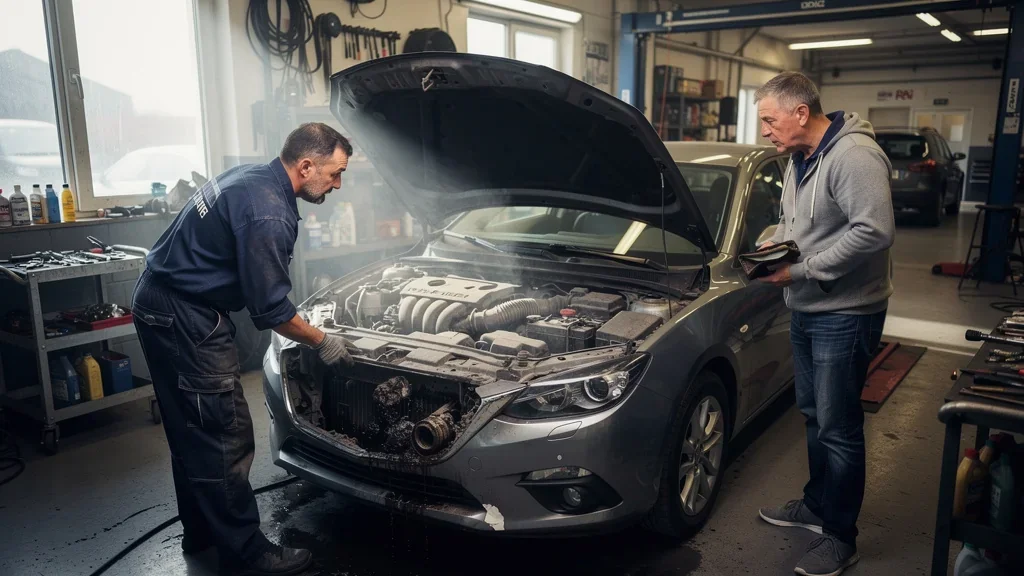
At the Renault Bastille Garage, beneath the bright lights of lift number two, a mechanic laid out the flattened old O-ring on the workbench. The repair cost came to €400. What stood out most was the greasy black ring he pointed to, right next to a still-warm Facom drain pan. It became clear to me at that moment that my oil filter was far from “almost good.”
The Saturday I Thought It Would Hold
I had performed the oil change on a gray Saturday, with the engine still warm and the car squeezed into a tight spot behind the building. In my haste, I felt an unwarranted confidence that an oil filter couldn’t let me down. After years of tinkering with my vehicles, I had taken the process for granted.
The mistake occurred during installation. I wiped the surface too quickly and then screwed on the new filter without noticing that the old O-ring had remained stuck to the mounting surface. The new ring was placed on top of it, creating a double seal that was not visible at first glance. Everything seemed fine by hand, but that was misleading.
I tightened it just until it made contact, then a bit more for reassurance, even using pliers once, despite my earlier promise to avoid that. This was a poor choice. The O-ring was marked, then crushed, and the threading became slightly misaligned. I had a nagging doubt but dismissed it too quickly.
Even worse, I didn’t check the oil level after the job was done. I packed up my tools, closed the hood, and drove off. At that moment, I felt confident, but in reality, I was just rushed and careless. This lack of verification reminded me of a previous article about a home oil change without a catch pan. The filter looked clean, but the mounting surface was anything but.
The Smell of Burning Oil That Caught Up with Me
The first real signal came after just 18 kilometers. At the first red light, a hot oil smell entered the cabin. Two minutes later, it was still there. Initially, I thought it was just a drop that had fallen somewhere on the engine block. However, upon arriving at the parking lot, I noticed a small stain on the ground. I looked closer, unwilling to believe what I saw.
When I opened the hood, I found a shiny ring around the base of the filter. The O-ring was worn on one side, flattened and crushed across the filter mount. I also spotted oil splattered on the cradle and beneath the engine mount. The smell originated from there, intensifying when the oil contacted the exhaust. It was simply a slow leak that I had caused myself.
The oil warning light flickered for two seconds, then nothing. This false calm made me lose even more time. A few kilometers later, stuck in traffic, the temperature gauge began to fluctuate. At that point, I couldn’t pretend anymore. The level on the dipstick had already dropped. I saw it clearly, unable to craft another narrative.
What struck me was the contrast between the initial silence and the subsequent leak. When stationary, everything appeared clean. But while driving, the heat did its work, deforming the O-ring and allowing the oil to find its escape route. I had underestimated a tiny mistake. It was precisely the type of detail one considers insignificant until it incurs significant costs.
The Garage, the Removed Engine Cover, and the Rising Bill
At the garage, the mechanic lifted the car and quickly removed the under-engine cover, demonstrating the efficiency of a certified professional. He pointed out the old O-ring that had remained stuck on the mounting surface. He also highlighted the fresh oil trace around the filter. I had no defense; I had simply missed a basic check. This same methodical observation had helped me diagnose a strange engine warning light during a 200-kilometer drive.
The repair escalated step by step. They had to address the leak, redo the oil change, install a clean filter, and then clean the underside of the engine. The compartment was greasy all the way to the engine mount. They also checked the lubrication circuit, let the engine idle for ten minutes, and then rechecked the dipstick—an essential step not to overlook before purchasing a used vehicle. This same reflex of checking after an oil change was something I had noted in my article about my first oil change. The engine had already taken a slight hit during the drive.
What added to the bill was the complete cleaning. Oil had flowed onto the engine block and then towards the cradle. Just this clean-up reminded me that I had paid for the same mistake twice: once with my actions and once at the counter. I ended up with a €400 bill for a filter that should have cost me much less than a standard service fee.
The time lost frustrated me even more than the expense. I had spent a long time searching for the wrong fault. I considered a hose issue, then a valve cover gasket problem. The real issue had been right in front of me from the start. The garage identified the cause in just a few minutes, while I had already exhausted my patience over a false mystery.
What I Should Have Checked Before Restarting
I should have wiped the mounting surface with a clean cloth. I should have verified that the old O-ring wasn’t stuck. I should have visually checked the filter’s seating before forcing anything. And I should have stopped at a firm contact, without pliers or any nervous extra turns.
The difference between a properly seated O-ring and one that is pinched is straightforward. In the moment, it seems secure. Then the heat comes, the O-ring compresses, and the leak begins. I saw it in hindsight. At startup, everything appeared normal. Later, the leak would return. This delay had deceived me.
Since then, I’ve paid attention to the most trivial signals: a stain under the car, the black ring around the filter, the level dropping for no reason, and the smell of hot oil when it hits the exhaust. The fleeting warning light too; that day, it gave me a two-second alert, nothing more. That was already enough.
I’m not discussing a theoretical case. I’m talking about a poorly installed oil filter, an old stuck O-ring, a slow leak, and an overheating situation narrowly avoided during a home oil change without a catch pan. At the Renault Bastille Garage, this mistake cost me €400 and a valuable lesson. Since then, I take five minutes to check the mounting surface. It’s the only reflex that has truly proven useful.
Now, I view an oil filter as a complete unit: mounting surface, O-ring, level, traces, and undercarriage. It’s not glamorous. That’s precisely what makes it deceptive. At the Renault Bastille Garage, under the lights of lift number two, I learned that a poorly checked detail can lead to a complete breakdown. And this time, I didn’t invent any excuses.