Shanghai Innovates Traffic Management with Dynamic Roadways
Shanghai introduces a dynamic roadway system that adjusts lane configurations based on traffic flow, utilizing solar-powered mobile barriers for enhanced efficiency.
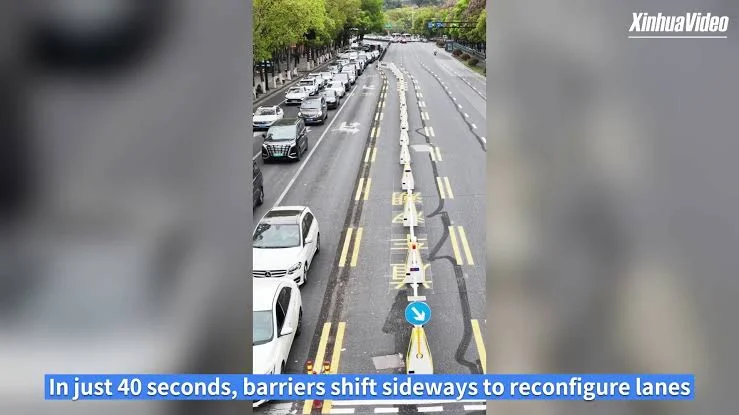
In an effort to combat traffic congestion, Shanghai has introduced a revolutionary approach to road management that allows the configuration of streets to change based on real-time traffic conditions. This innovative system utilizes mobile traffic barriers that can be controlled remotely and are powered by solar energy.
The primary goal of this initiative is to optimize the use of existing road space during peak traffic times. For instance, during rush hour, many drivers may be heading towards the same area of the city, while lanes in the opposite direction remain relatively clear.
Rather than maintaining a static roadway, this system enables the modification of the number of lanes available in each direction. This concept is an evolution of the so-called “tide lanes,” already implemented in other Chinese metropolises like Nanjing and Yinchuan. The term aptly describes the functionality: similar to how water ebbs and flows, the space allocated to each traffic flow can increase or decrease throughout the day.
Understanding “Tide Lanes”
The principle behind tide lanes addresses a common scenario in large cities. In the morning, a significant volume of traffic might head towards specific areas, while the flow may reverse in the afternoon or evening. With a traditional road setup, the number of lanes remains constant regardless of the actual traffic volume in either direction.
Tide lanes, however, aim to adapt the road to meet demand. For instance, if heavy congestion builds in one direction while the opposite lane experiences lighter traffic, part of the roadway can be temporarily allocated to the busier flow. When traffic patterns shift, the configuration can be adjusted again.
A crucial component of this system is the automated traffic barrier, which physically separates the two directions of traffic and can shift laterally. It's important to note that individual lanes are not continuously widened or narrowed; instead, the number of lanes assigned to each direction changes. Thus, the overall roadway remains the same, but its utilization is adjusted based on current needs.
This dynamic solution is complemented by visual signals and flashing lights that indicate the configuration, while yellow road markings delineate the areas affected by the system.
Remote Control of Barriers in Shanghai
What sets Shanghai's implementation apart is the management of these infrastructures. A video released by Xinhua showcases the mobile barriers as they shift along the roadway, reconfiguring the distribution of available space for both traffic flows.
The intelligent mobile barriers can be controlled remotely, eliminating the need for operators to be physically present on-site for every traffic modification. This detail is significant; a dynamic solution is most effective if it can be reconfigured quickly. If changing the number of lanes required a lengthy manual process each time, much of the advantage would be lost.
Instead, this system aims to make the transformation of the roadway more rapid and responsive to traffic fluctuations. Central to the concept of tide lanes is the monitoring of traffic through a network of sensors, which helps determine where vehicles are concentrated. In essence, the road is no longer viewed as a completely static infrastructure.
Solar-Powered Mobile Barriers
Shanghai has also incorporated another distinctive feature: the use of solar energy to power the new intelligent mobile barriers. The elements installed on the roadway can thus harness locally produced energy to support the system's operation.
This project aligns with the broader concept of smart roads, where the roadway serves not just as a surface for vehicle transit but integrates technologies capable of managing traffic flow more flexibly.
The declared aim is to enhance safety and efficiency by adapting the infrastructure to fluctuations in traffic. While it won’t eliminate congestion, a mobile barrier allows for a more effective distribution of available space when demand is heavily imbalanced, thus providing a clear advantage.
Adjusting Lanes Where Needed Most
Consider a road with a fixed number of lanes divided between two directions. If one side is nearly empty while the other is gridlocked, a static configuration represents an inefficient use of space.
With a mobile barrier, it becomes possible to shift the dividing line and grant an additional lane to the more congested direction, temporarily reallocating it from the side with less traffic. When conditions change, this process can be reversed. This is where the analogy with tides becomes relevant: roadway space “advances” in one direction and “recedes” in the other, following the flow of traffic. This solution is particularly suitable for major arteries characterized by predictable and significantly varying traffic flows throughout the day.
Transforming Shanghai’s Roadways into Dynamic Infrastructures
In a sprawling metropolis like Shanghai, managing daily commutes is an immense challenge. The solar-powered, remotely controlled barriers represent a departure from traditional solutions, such as constructing new lanes or continuously widening roads.
Instead, the focus is on maximizing the existing infrastructure. The immediate benefit for drivers is clear: if the majority of vehicles are heading in the same direction, the road can allocate more space to that flow.
Of course, such a system requires precise management of signage and lane separation, as drivers must clearly understand which lanes are available.
The Chinese experience with tide lanes, already adopted in cities like Nanjing and Yinchuan, continues to evolve. In Shanghai, the innovation lies in the intelligent barriers that can be activated remotely and are powered by solar energy. This approach does not magically increase road size; rather, it seeks to be smarter in utilizing the space already available. During peak times, when all vehicles seem to converge in one direction, even a single additional lane can make a significant difference.