Home Oil Change Kit vs. Garage: A Timed Cost and Time Comparison
A detailed comparison of performing an oil change at home versus at a garage, analyzing costs, time spent, and the overall experience.
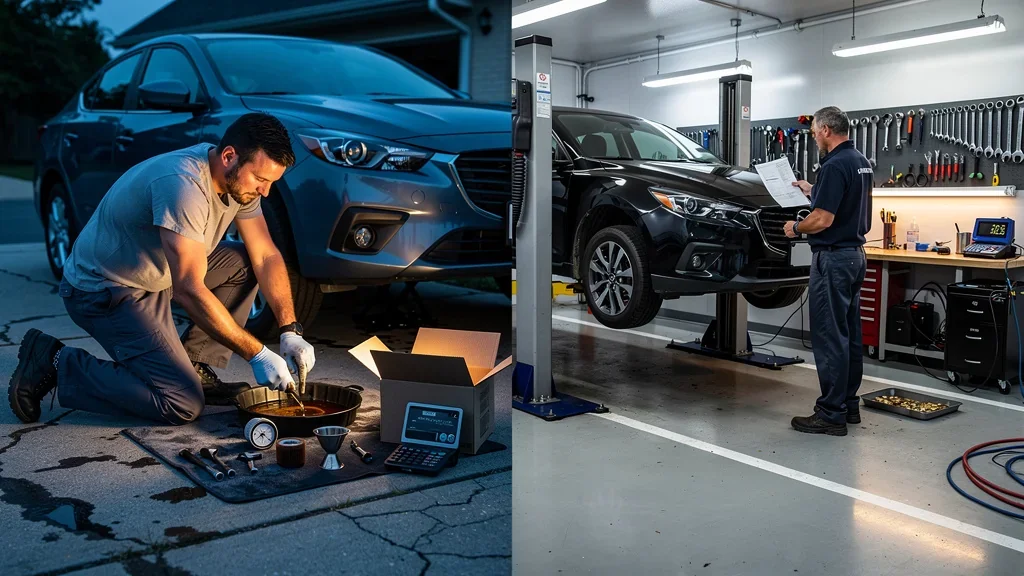
The home oil change kit slid across the cold concrete. The smell of oil hit me before I even opened the hood of my Peugeot 308. Next to me were a recovery pan, a headlamp, TotalEnergies Quartz 5W-30 oil, and a Norauto quote for €93. My aim was to compare the same operation at home and at the garage, with the engine still cold. I began by inspecting the gray floor, counting my movements rather than relying on a quick tutorial. Although I had experience changing oil on other cars, this one was different due to its under-engine cover that needed to be removed.
Preparing the Car
I parked the vehicle level in the driveway and left the hood closed for 7 hours and 12 minutes before starting. For this model, I needed to remove an under-engine cover secured by 6 Torx screws and 2 quarter-turn clips. The first clip popped off on the left side, rolling under the front right wheel. I had to retrieve it with a telescopic magnet before proceeding calmly.
I had €39 worth of oil, €13 for a Purflux filter, and €5 for a drain plug gasket, totaling €57 in consumables. I kept my oil filter wrench, a 9-liter recovery pan, and the torque wrench I’ve used for three years for regular maintenance. I no longer rely on feel for tightening. This engine uses a cartridge filter in a bell, not a screw-on filter. I checked the O-ring in its groove before closing up and tightened the plug to 28 N·m with a new gasket.
I was focused on determining the actual final cost, the useful working time, the hidden time for cleaning, and the trips I could avoid. The garage quoted €93, which included resetting the maintenance light and disposing of the used oil, a service often linked to poor oil filter installation. I noted this price next to the pan, wanting to understand the margin after accounting for my dirty rags and blackened hands. I also kept in mind that a straightforward quote sometimes obscures the waste management and final checks involved.
The Importance of Hidden Time
I started my stopwatch when I opened the hood and stopped it after the last wipe of the cradle, totaling 1 hour and 24 minutes. Just removing the under-engine cover took 17 minutes, followed by 20 minutes for the oil to drain. Then, I spent 8 minutes on the plug, 11 minutes on the filter, 7 minutes on refilling, and 21 minutes checking for traces and cleaning the floor.
The filter presented my first challenge. The grip slipped after a quarter turn, and the cartridge resisted more than expected. I ended up using a strap wrench and then a claw wrench, which slipped a bit more. Black oil ran down my forearm to my wrist. I protected the cradle and the plastic cover with two rags. The filter bell was draining poorly, causing oil to trickle in an area I hadn’t covered.
I also checked the plug gasket before reattaching it because an old gasket leaves an oily residue around the thread after the first start following an oil change. This reflex to inspect everything when closing up was something I emphasized in my article about my first oil change. When I felt the wrench becoming less effective, I stopped applying force. I tightened in small increments instead of trying for that last quarter turn. At the bottom of the pan, I noticed very fine gray dust, not shavings, which reassured me. After 6 minutes of rest, I checked the dipstick again and performed a safety check before lowering the car.
The Bill and the Real Difference with the Garage
I spent €57 on consumables, with €39 for the oil, €13 for the filter, and €5 for the gasket, which can be compared to a €199 service package. If I had to repurchase the oil filter wrench, the recovery pan, and the torque wrench, I would add €148, bringing the total to €205. The difference compared to the garage’s €93 service became clear, highlighting the poor calculations that my poorly installed oil filter reminded me of.
I also paid for the peace of mind that comes with checking the level, resetting the maintenance light, and disposing of the used oil. I verified this against the ADEME guidelines on waste collection. On busy days, I prefer not to block the driveway with the car on jacks for two hours. I still have to store the pan and wash the rags. The garage's fee also covered the absence of greasy floors and the disposal of the canister elsewhere. I kept this in mind as I observed the time ticking away from the first loosening to the final wipe.
The moment of doubt arrived at the first start. I noticed moisture around the plug and a small dark mark on the oil pan. I shut off the engine, checked the tightness, and readjusted the plug slightly. I briefly considered a misaligned gasket. If I had over-tightened it, I could have damaged the oil pan thread, which would have altered my budget.
What I Gained and What I Didn’t
In total, I spent 1 hour and 24 minutes on this oil change, with 38 minutes of actual work under the car and 21 minutes of cleaning that never count in quick tutorials. On a simpler car, where the filter unscrews from the top and the under-engine cover isn’t obstructive, I could have significantly shortened the session. On this Peugeot 308, the undercarriage dictated the pace.
I appreciated being able to choose my oil down to the liter and inspect the bottom of the pan, as the gray dust informed me about the engine's condition in the garage. However, I disliked my blackened hands, the clanging of the metal pan on the concrete, and the lingering smell of used oil that followed me to the gate. I noticed a droplet fall from the plug onto the garage floor just five minutes before my departure. This slight delay reminded me that I wasn’t quite done with the mechanics when I thought I was finished. I encountered that same leak in my article on an oil change without a catch pan, where I wiped that droplet twice.
My conclusion, in light of the Norauto quote and ADEME guidelines, is straightforward: the home kit wins on cost when the car is accessible and I already have my tools. For someone willing to spend 1 hour and 24 minutes getting dirty and wanting to manage the oil and filter, it’s a yes. However, as soon as the under-engine cover complicates things, a gasket raises doubts, or a leak might ruin my evening, I’ll gladly hand the job over to the garage for changing the brake pads. I concluded this test with a clear limit: savings are possible, but they depend as much on access to the undercarriage as on the price displayed at the counter. This reflects the same kind of choice between savings and trust that I explored further in my article on synthetic oils.