Winter Windshield Washers Tested: Bosch vs. Liqui Moly
In a comparative test of winter windshield washer fluids, Bosch and Liqui Moly were evaluated for their freezing resistance. The results revealed significant differences in performance under cold conditions.
During a recent test of winter windshield washer fluids, I opened the hood of my Corolla in the Carrefour Poitiers Sud parking lot and was splashed by the winter washer fluid. As an automotive journalist for CarBling, I decided to experiment with two different products: Bosch and Liqui Moly. With my partner and I both relying on our vehicles, I wanted to ensure we wouldn’t wake up to a frozen windshield.
Preparing for the Test
I set out with two 5-liter containers and two partially filled reservoirs—one in my Corolla and the other in a friend’s Clio. I poured a bit of summer fluid into each reservoir without purging them, then filled one with Bosch winter fluid and the other with Liqui Moly winter fluid. This approach was not ideal, but I was curious to see how a true mixture would perform.
Choosing a clear night with a forecast of -5°C, I aimed to compare the outdoor cold to that of a freezer. I deliberately avoided purging the reservoirs to keep the summer fluid hidden in the lines, where it would remain unnoticed. After placing the two cars outside, I returned late that evening, eager to observe their performance the next morning.
I anticipated a simple reduction in flow, not a complete blockage. The -20°C labels on the bottles had me intrigued, and I was determined to see if the fluids could withstand the cold as advertised. My experience as an automotive journalist told me that the numbers on the bottle often don’t tell the whole story.
To monitor the performance, I left a small transparent glass on my workbench to observe any sediment and the appearance of the liquids. I expected a sharp, alcoholic smell upon opening, as this detail had previously alerted me to issues in other tests. My goal was to avoid discovering problems at the worst possible moment, such as when the windshield was coated in salt and grime.
Observations After Freezer Testing
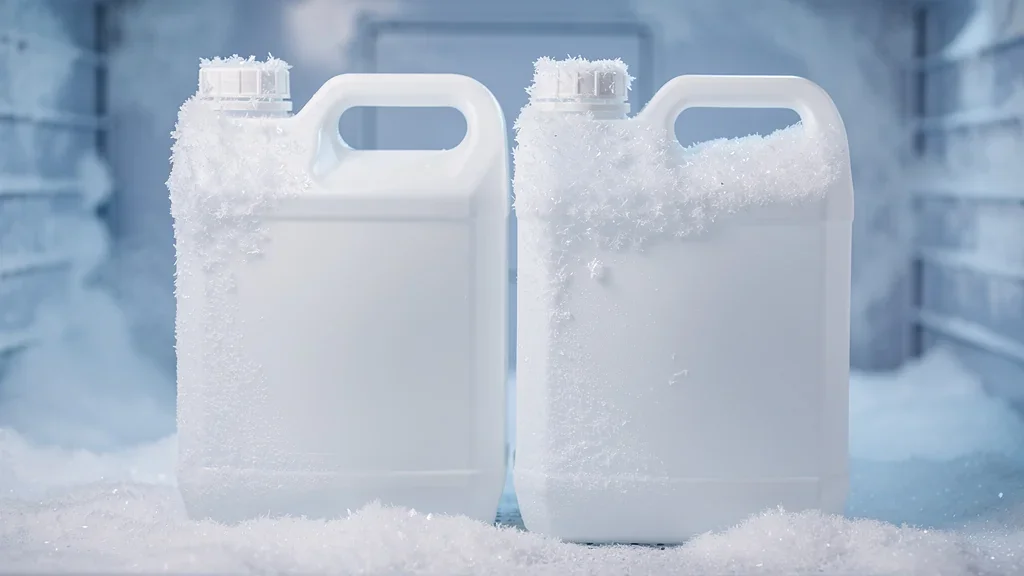
I placed each bottle in my home freezer at -18°C for 12 hours, ensuring the caps were tightly sealed and without shaking them. Upon retrieval, I noticed that the Bosch fluid had turned thick and slushy, while the Liqui Moly remained more uniform, with only a few specks visible in the glass.
Opening the Bosch first, I was hit by a strong alcoholic odor. Although the fluid was still flowing, it did so in spurts, resembling melting snow under light. In contrast, the Liqui Moly maintained a more consistent flow, with only minor flakes detected at the bottom of the container.
After spending the night in the freezer, the Bosch bottle became slushy, while the Liqui Moly remained fluid. I was struck by the difference in performance. On my Corolla, the Bosch pump ran for four seconds without dispensing any fluid before finally trickling out a few drops, followed by a dry silence before it resumed.
The spray from the Bosch was erratic, leaving a dry patch in the middle of the windshield. I had to activate the switch multiple times to achieve a proper wash. The pump sounded labored and failed to deliver a clean spray.
In contrast, the Liqui Moly responded more quickly, producing a stream in just two seconds, albeit a bit weak, but sufficient to clear the salty haze. The windshield showed fewer streaks, and I didn’t experience the feeling of a struggling nozzle.
Complications in the Testing Process
I initially made the rookie mistake of not purging the reservoir. I realized that even a small amount of residual summer fluid could dilute the winter washer fluid enough to compromise its freezing resistance, explaining the frequent failures I had observed in winter without understanding their cause. When I repeated the test without the residual fluid, the flow improved significantly.
I also experimented with a diluted mixture using water in a separate bottle, only to see it cloud up quickly and develop an unclean appearance. Buying the cheapest bottle taught me the same lesson: lower price doesn’t always equate to better performance in cold temperatures.
I acknowledge that my freezer does not replicate real-world conditions, and I remain aware of this distinction. At -18°C, I observed how the fluids behave in dry cold, but I couldn’t account for the effects of repeated nights outside and a dirty windshield. For a clogged nozzle that requires purging, I would leave that to a qualified mechanic, as I didn’t want to take unnecessary risks.
What surprised me was the unexpectedly strong odor from the Bosch, which did not correlate with better performance. I also noticed invisible crystals initially, but the pump revealed them immediately with a prolonged noise before the spray. Upon returning, I retained one key insight: a bottle can mislead more easily than the pump can.
Final Verdict on Washer Fluid Choices
My conclusion is straightforward: the Liqui Moly performed better in my tests. After 12 hours at -18°C, the fluid remained pourable, and the spray returned in just two seconds at -5°C. The Bosch, however, turned slushy much faster, and its pump struggled for four seconds before delivering a weak stream.
The mixture with summer fluid or water cost me the best part of the test, and I now categorize it as a poor decision. When the fluid thickens, it leads to a skewed spray, then spurts, and finally a windshield that retains dirt instead of clearing it. This is when partial clogs become troublesome, as the vehicle sprays poorly before ultimately blocking completely.
For someone willing to purge the reservoir before winter, my advice is clear: it’s wiser to use a proper winter formula and keep any summer fluid out of the circuit. For those who drive infrequently, sleep outside in -5°C, and already scrape their windshields in the morning, I wouldn’t recommend mixing. I keep a spare bottle in the garage and ensure I have a buffer above the advertised temperature, even if Bosch or Liqui Moly make big promises on their labels.
Alongside my partner, with no children, I prefer a smooth start over a pump that sputters at the door. My test has left me with a simple rule: the product that remains fluid after 12 to 24 hours in the freezer handles cold better, and mixing with summer fluid or water quickly undermines the results. My verdict, following a night at -18°C and a morning at -5°C, remains the same as when I saw the Bosch turn slushy: I no longer trust it without a proper purge.